














As we all experienced on Monday morning, the WiFi in the building went down while many of us were using it to work on assignments or projects. This technical failure proved to be a large disruption in classes across the building. Many teachers had to pause lessons or assign different work than they had planned, and many ended up allowing for unstructured time for the whole period. This disruption had me thinking about how our school operated before we had the technology that we so often take for granted.
Since Doherty Memorial was founded in 1966, we have seen plenty of technological changes over the years, from the obvious, like the flashy TVs mounted throughout the new building, to those we take for granted, like the internet that supports our education in so many ways. But it surely was not always this way. Any junior or senior could recount how our old building barely had running water in the bubblers and air conditioning that was unreliable at best.
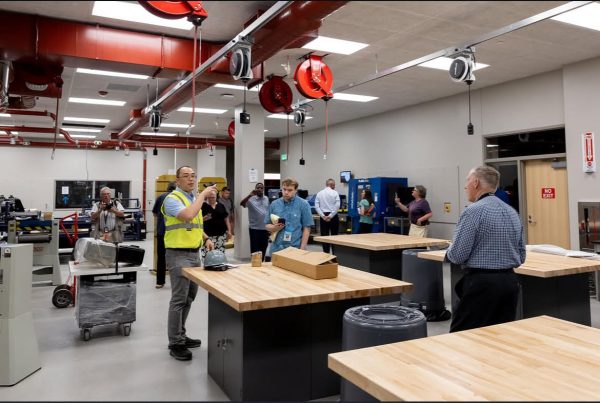
While the old building was full of memories and nostalgia, it was certainly due for an upgrade. The new Doherty is a 422,000-square-foot, fully electric, state of the art facility, now the largest school in the City of Worcester, home to 1,560 students. From state of the art spaces for arts and athletics to expanded career technical education facilities, the new building was designed for success from the ground up. The technology inside it matches that ambition in a way the old building never could.
The contrast between old school and modern technological education came into focus most sharply at the end of last semester in the old building, when Doherty held its finals week entirely online. Students logged in from home, submitted work online, and completed assessments without ever setting foot in a classroom. For those of us who lived and learned through COVID-era schooling, there was something familiar about it, like the strange quiet of learning through a screen, the absence of a teacher’s presence, the lack of the in-class atmosphere that is so familiar. This system worked more or less. But it also reminded us just how much our education methodology has shifted, and how we now rely so much on technology.
This shift did not happen overnight, and it did not come without cost or without people who fought to make it equitable. Ms. Coonan, one of Doherty’s Computer Science teachers, put it plainly: “Before the school gave out Chromebooks, kids would have to purchase their own computer to take my course.” That sentence carries more weight than it might first appear. For students from families without the means to buy a personal computer, a course on computer science or programming would simply be off limits. This is a great example of digital divide in real familiarity. This divide could be the difference between a student who graduates with marketable technical skills and one who never got the chance to develop them. When schools invest in closing that gap, we not only gain flashy new tech but also real opportunities for students. They are investing in futures and giving students a real foundation for college and career readiness.
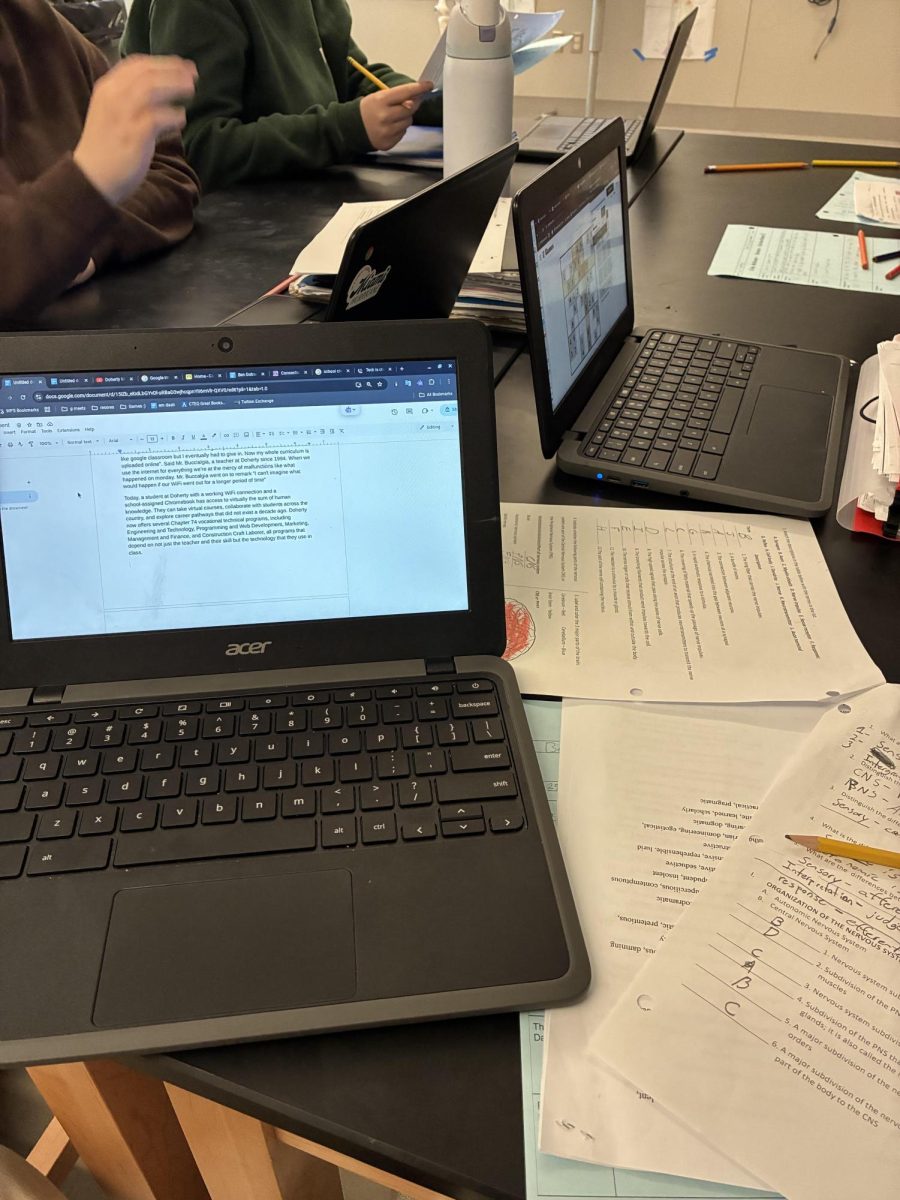
This is where the conversation about technology in education becomes something more than nostalgia. Before the internet, our high school education would be at the mercy of the textbooks a school had, and the knowledge of the teacher. The phrase “searching up” meant literally searching through textbooks and encyclopedia volumes. But now we carry so few, often little to no physical textbooks as we have nearly all of our resources uploaded to internet services. “We rely too much on the internet, I originally resisted the use of online education like Google Classroom but I eventually had to give in. Now my whole curriculum is uploaded online,” said Mr. Buccialgia, a teacher at Doherty since 1994. When we use the internet for everything we’re at the mercy of malfunctions like what happened on Monday. Mr. Buccalgia went on to remark, “I can’t imagine what would happen if our WiFi went out for a longer period of time” expressing his concern on how much we rely on the internet for teaching today.
Today, a student at Doherty with a working WiFi connection and a school-assigned Chromebook has access to virtually the sum of all human knowledge. They can take virtual courses, collaborate with students across the country, and explore career pathways that did not exist a decade ago. Doherty now offers several Chapter 74 vocational technical programs, including Engineering and Technology, Programming and Web Development, Marketing, Management and Finance, and Construction Craft Laborer, all programs that depend on not just the teacher and their skill but the technology that they use in class.
With how much our education, for better or worse, now relies on technology might be why Monday’s outage was felt the way it did. We are no longer simply inconvenienced when the WiFi fails. We are, in a real sense, cut off from our education itself.