














Happy LGBTQIA+ Pride Month!
The Pride flag began in San Francisco in 1978 as a symbol for the LGBTQIA+ community. Artist and activist Gilbert Baker, inspired by Harvey Milk, wanted a symbol that showed openness and identity. Baker believed the flag was a direct way to express presence and identity.
The first rainbow flags appeared at the San Francisco Gay Freedom Day Parade on June 25, 1978.
The Seven‑Stripe Version (1978–1979)
The very first version had eight colors, each with a meaning:
- Hot pink — Sex
- Red — Life
- Orange — Healing
- Yellow — Sunlight
- Green — Nature
- Turquoise — Magic/Art
- Indigo — Serenity
- Violet — Spirit
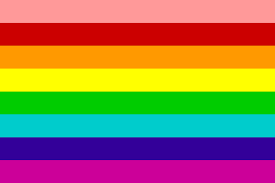
The original flag design had eight stripes, with a specific meaning assigned to each of the colors. These flags were hand‑dyed and stitched by 30 volunteers, including artist Lynn Segerblom.
The Six‑Stripe Standard Flag (1979 Updated Version)
Soon after the flag debuted, demand increased–especially after Harvey Milk’s assassination. But hot pink fabric wasn’t available, so the flag was reduced to seven stripes, so Baker dropped it. In 1979, the flag changed again. To hang the design evenly on streetlamps, Baker removed turquoise, leaving:
Red, Orange, Yellow, Green, Blue, and Violet.
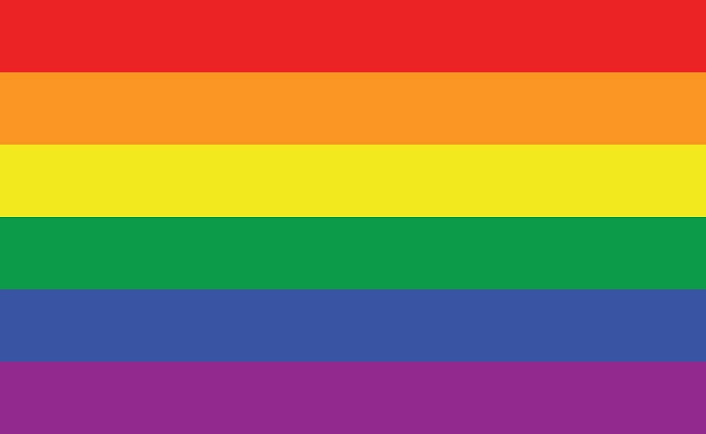
This is the version most people recognize today, and the result was the six‑stripe version of the flag that would become the standard for future production.
From the 1980s onward, the Pride flag became a global symbol:
- In 1989, a court case in California protected the right to display it.
- In 2004, activists used it as the flag of the symbolic Gay and Lesbian Kingdom of the Coral Sea Islands.
- In 2015, the White House was illuminated in rainbow colors after same‑sex marriage was legalized nationwide.
- In 2016, the rainbow flag emoji (🏳️🌈) was officially added!
The White House was illuminated in the rainbow flag color, following the Obergefell v. Hodges decision.
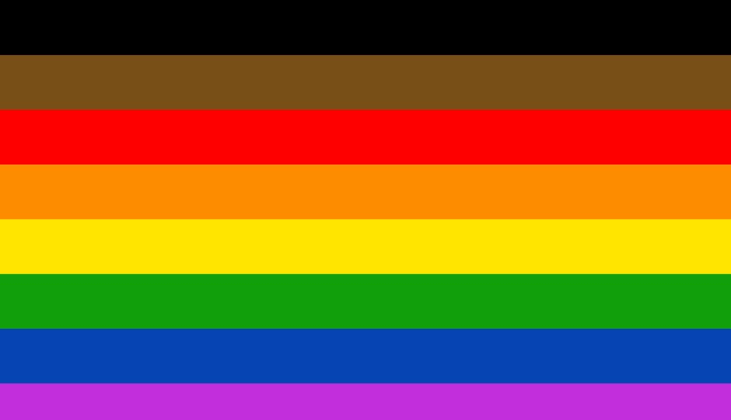
Philadelphia’s “More Colors More Pride” Flag
Progress Pride Flag (2018)
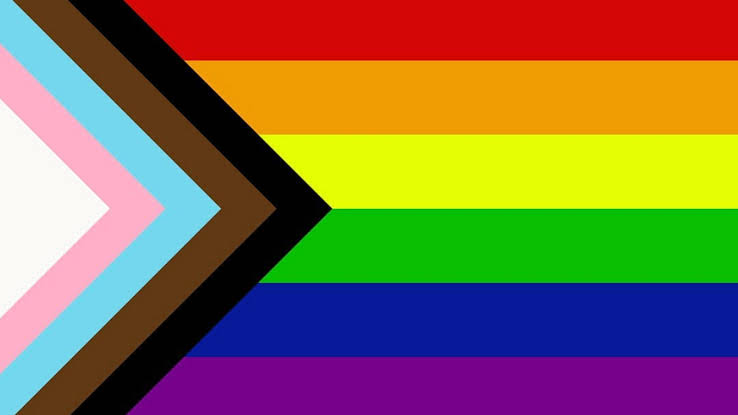
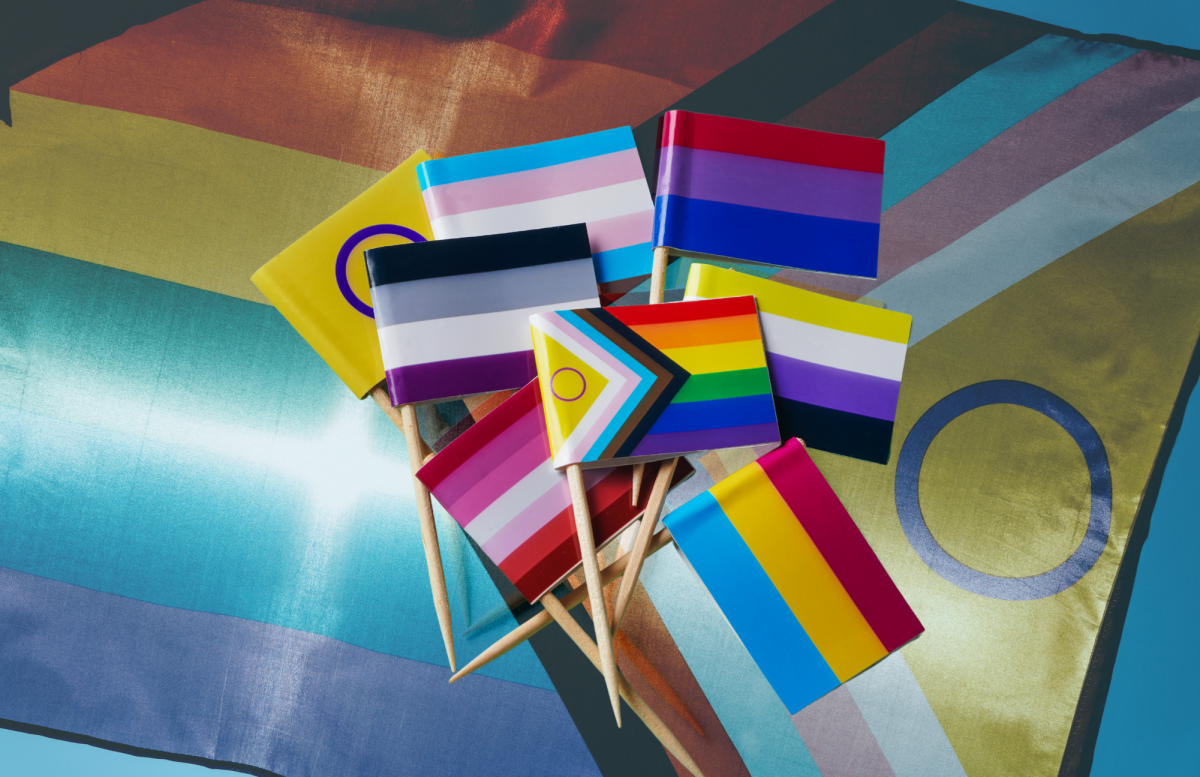
Today, many versions of the Pride flag exist to represent different identities and causes, such as:
Intersex-Inclusive Progress Pride Flag (2021)
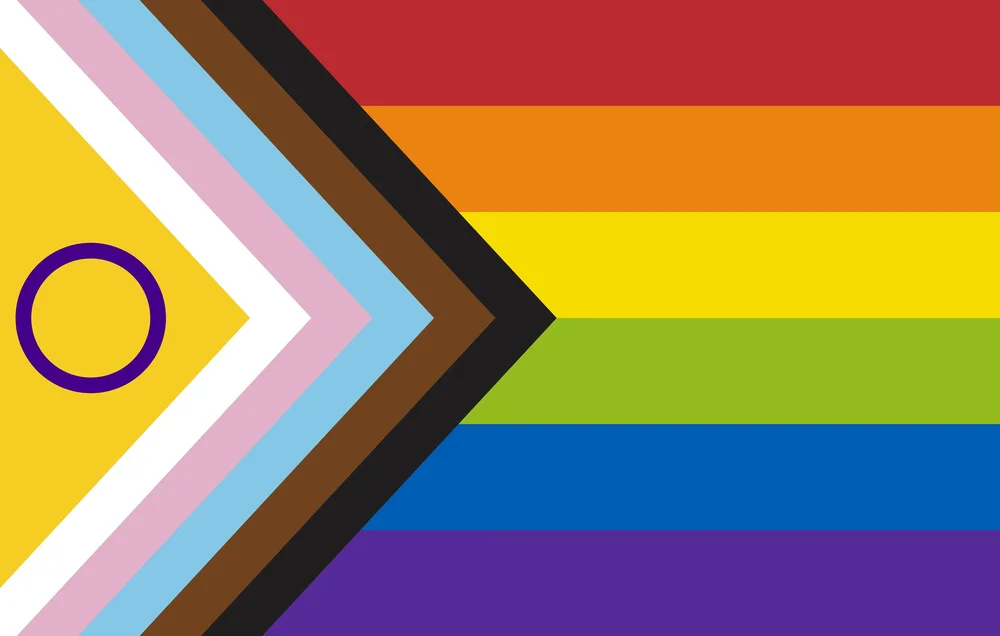
However, over the years, individuals have created several labels and flags that correspond with their sexual or gender identity, and it includes the following:
- Abrosexual — A sexual orientation that changes over time (frequency, intensity, or type of attraction).
- Achillean — A man or masculine‑aligned person attracted to men/masculine‑aligned people.
- Agender — Someone who has no gender identity or feels a neutral gender.
- Androgyne — A gender identity blending or existing between masculinity and femininity.
- Androsexual — Attraction toward masculinity or masculine‑presenting people.
- Aroace — Someone who is both aromantic and asexual.
- Aromantic — Someone who generally does not experience romantic attraction.
- Asexual — Someone who generally does not experience sexual attraction.
- Bigender — A person who has two distinct gender identities.
- Bicurious — Someone exploring or questioning attraction to more than one gender.
- Bisexual — Attraction to more than one gender.
- Boyflux — Fluctuating intensity of masculinity (from fully boy to partially boy to agender).
- Butch lesbian — A lesbian who expresses herself in a masculine or butch way.
- Ceterosexual — Attraction to non‑binary or gender‑nonconforming people.
- Demiboy — Someone who partially identifies as a boy or man.
- Demigender — A partial or fractional connection to a gender.
- Demigirl — Someone who partially identifies as a girl or woman.
- Demioromantic — Someone who only experiences romantic attraction after forming an emotional bond.
- Demisexual — Someone who only experiences sexual attraction after forming an emotional bond.
- Drag — A performance art involving exaggerated gender expression, often tied to queer culture.
- Gay — A man attracted to men.
- Genderfluid — A gender identity that shifts over time.
- Genderflux — Fluctuating intensity of one’s gender identity.
- Genderqueer — A gender identity outside or beyond traditional categories.
- Girlflux — Fluctuating intensity of femininity.
- Graysexual — Someone who experiences sexual attraction rarely or under limited circumstances.
- Gynesexual — Attraction toward femininity or feminine‑presenting people.
- Hijra — A recognized third‑gender role in South Asian cultures.
- Intersex — Born with sex traits that don’t fit typical male/female definitions.
- Labrys lesbian — A lesbian identity associated with feminist and lesbian resistance symbolism.
- Lesbian — A woman attracted to women.
- Lipstick lesbian — A lesbian who expresses herself in a feminine way.
- Lithromantic — Someone who feels romantic attraction but does not desire reciprocation.
- Maverique — A gender identity independent of male/female/non‑binary categories.
- Neutrois — A neutral or null‑gender non‑binary identity.
- Non‑binary — A gender outside the categories of man and woman.
- Omnisexual — Attraction to all genders with awareness of gender.
- Pangender — Identifying with many or all genders.
- Pansexual — Attraction regardless of gender.
- Polygender — Having multiple gender identities.
- Panromatic —A romantic orientation where someone can develop romantic feelings for people of all gender.
- Polyamorous — Desire or practice of multiple consensual relationships.
- Polysexual — Attraction to multiple genders (not necessarily all).
- Pomosexual — Rejecting traditional sexual orientation labels entirely.
- Queer — An umbrella term for diverse sexual and gender identities.
- Questioning — Exploring one’s gender or attraction.
- Sapphic — Women or feminine‑aligned people attracted to women/feminine‑aligned people.
- Transgender — Someone whose gender identity does not align with their sex assigned at birth.
- Trigender — Having three gender identities.
- Two‑Spirit — A term used by some Indigenous peoples for individuals embodying multiple gender roles.
Scholars describe the Pride flag as a “floating signifier,” meaning its meaning changes depending on who uses it. It can unite communities or spark debate. Flags are ambivalent symbols that hold different ideologies, meanings, and agendas depending on the beholder.
Pride Month is not only a celebration of identity but also a remembrance of those we’ve lost to hate‑motivated violence, discrimination, and the AIDS crisis. It is a time to honor their memory by continuing the fight for safety, dignity, and equality for every LGBTQIA+ individual out there. As we raise the Pride flag, we carry their stories forward and reaffirm our commitment to a world where everyone can live openly, proudly, and without fear.
Happy LGBTQIA+ Pride Month!
“We are a global tribe, we exist everywhere. But we are not free everywhere.” — Gilbert Baker.
Sources:
- https://en.wikipedia.org/wiki/Rainbow_flag_(LGBTQ)
- https://flagmakers.co.uk/blog/pride/the-history-of-the-pride-flag/
- https://www.hrc.org/resources/lgbtq-pride-flags
- https://sdpride.org/hidden-history-of-the-pride-flag/
- https://humanrights.ca/story/symbol-pride
- https://www.glbthistory.org/rainbow-flag
- https://www.vam.ac.uk/articles/the-progress-pride-flag?srsltid=AfmBOoqPMnToC2K-xts6-R1Jb32Lrqq8O6TXs3YLUg-EE4muD5N0goO_
- https://friscolibrary.com/blogs/post/a-brief-history-of-the-pride-flag/
- https://www.cooperhewitt.org/2023/06/20/intersex-inclusive-progress-pride-flag-at-the-smithsonian/
- https://www.globalinclusiveprideflag.com/
- https://lgbtqia.fandom.com/wiki/Pride_flag_gallery